

- March 24, 2026
- Dr. Vikrant Kale
- 0 Comments
- Latest Blogs
ERCP: What It Is, Why It’s Done, Procedure, and Complications?
If you have been diagnosed with a blockage in your bile duct or a problem with your pancreas, your doctor may have suggested an ERCP. In the world of modern medicine, this procedure is often referred to as “Endoscopy Surgery” because it allows doctors to treat internal issues without making a single cut on the body.
When it comes to advanced endoscopic treatments, experience is everything. Dr. Vikrant Kale, a renowned Gastroenterologist in Pune, serves as the Director & Head of the Department of Medical Gastroenterology at the Kaizen Gastro Care Clinic, PCMC, Pune. With a staggering record of performing 5000+ gastroscopies, 3000+ colonoscopies, and 1000+ ERCP procedures, Dr. Kale is one of the most trusted names for complex gastrointestinal care in the region.
What is ERCP?
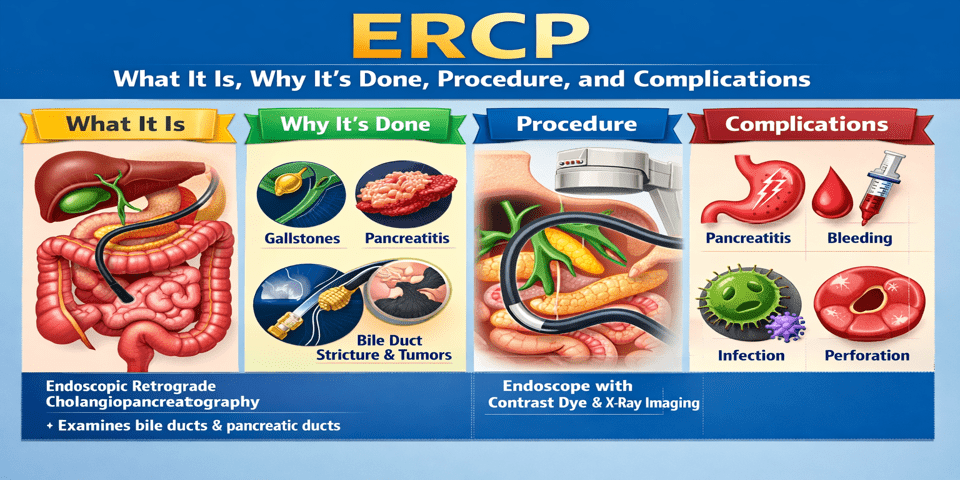
ECRP full form stands for Endoscopic Retrograde Cholangiopancreatography. It is an advanced endoscopic procedure primarily used for the treatment of the biliary system.
While the ercp medical abbreviation might sound complex, the ercp meaning is quite straightforward:
- Endoscopic: Refers to the use of an endoscope (a thin, flexible tube with a camera).
- Retrograde: Means the doctor injects a dye “backward” into the ducts.
- Cholangiopancreatography: Refers to the X-ray imaging of the bile ducts (cholangio) and pancreatic ducts (pancreato).
Earlier, this was used mostly for diagnosis, but today, with the advent of MRI and MRCP, ERCP is mainly therapeutic—meaning it is used as an ercp operation to fix problems rather than just find them.
Difference Between Endoscopy and ERCP:
Many patients ask how a standard endoscopy differs from an ERCP Test in PCMC Pune.
- Standard Upper GI Endoscopy: This examines the food pipe (esophagus), stomach, and the beginning of the small intestine. The camera looks straight ahead.
- ERCP: This uses a special side-viewing scope. This unique design allows the doctor to see the ampulla (the opening where the bile duct meets the intestine) directly. Because the camera is on the side, it requires a highly skilled expert like Dr. Vikrant Kale to navigate the scope blindly through the stomach and position it perfectly.
Why is ERCP Done? (Common Uses)
The most common reason for an ercp to remove stones is when gallstones slip out of the gallbladder and get stuck in the bile duct. This condition is known as choledocholithiasis ercp.
Other primary uses include:
- Treating bile duct blockages.
- Managing a cbd stricture (narrowing of the common bile duct).
- Placing stents to improve bile flow.
- Addressing pancreatic duct dilatation or other pancreatic problems.
Conditions That May Require ERCP:
You may need an ERCP treatment in Pune if you suffer from:
- CBD calculi (Stones in the common bile duct).
- Obstructive jaundice (Yellowing of eyes/skin due to blockage).
- Bile leak after a gallbladder surgery.
- Pancreatitis complications.
- Suspected bile duct or pancreatic cancer.
When ERCP Cannot Be Used (Limitations)?
It is important to understand that while ERCP is powerful, it has limits:
- It cannot remove stones that are still inside the gallbladder (for those, you typically need a cholecystectomy).
- It cannot reach certain strictures located deep inside the liver.
- It is not a substitute for the steps of open cholecystectomy if the gallbladder itself is diseased.
How the ERCP Procedure is Performed?
Unlike a quick 5-minute diagnostic endoscopy, an ERCP takes about 30 to 45 minutes.
- Anesthesia: The patient is given sedation or general anesthesia. You won’t feel any pain or remember the procedure.
- Navigation: The scope passes through the mouth, stomach, and into the duodenum.
- Cannulation: A tiny guidewire is inserted into the 1mm opening of the bile duct.
- Contrast & X-ray: A contrast dye is injected, creating a cholangiogram (X-ray map) of the ducts. In some cases, a t tube cholangiogram procedure might be referenced for post-surgical mapping, but during ERCP, it is done in real-time.
Treatments Performed During ERCP:
Once the doctor identifies the problem via the cholangiopancreatography retrograde endoscopic view, they can:
- Perform a sphincterotomy (cutting the duct muscle to widen the opening).
- Use a balloon or basket for ercp to remove stones.
- Place a plastic or metal stent to bypass a cbd stricture.
Benefits of ERCP:
- Minimally Invasive: No external cuts or stitches.
- Fast Recovery: Most patients are back to a normal diet within 24 hours.
- Effective Relief: Immediate clearance of bile duct obstructions.
Possible Risks and Complications of ERCP:
- Minor bleeding.
- Infection.
- A “failed procedure” if the anatomy is too complex to navigate.
Why an Experienced Doctor is Important?
Bile duct anatomy varies significantly between people. Precise guidewire placement is a high-level skill. Dr. Vikrant Kale’s extensive experience with over 1000 ERCPs significantly reduces the risk of an ercp complication and ensures a higher success rate even in difficult cases.
Stent Placement and Removal:
Why is a Stent Placed?
A stent is a tiny tube that ensures bile keeps flowing while internal swelling goes down. It prevents recurrent blockages immediately after the ercp operation.
Why Stent Removal is Necessary?
An ercp stent removal is mandatory after 4–6 weeks. If left too long, the stent can become clogged and cause a severe infection. Dr. Vikrant Kale usually performs a repeat short endoscopy or ERCP to remove the stent and ensure the duct is 100% clear of any remaining cbd calculi.
Preparation and Recovery:
- Before: You must fast (NPO) for at least 8 hours. Inform Kale about any blood thinners you are taking.
- After: You will be monitored in the hospital for 24 hours. This is to ensure no delayed bleeding or pancreatitis occurs. Most patients go home the next day.
Common Questions About ERCP:
- Is ERCP painful? No, because it is done under sedation, you will be “fast asleep.”
- Can stones return? Yes, if the gallbladder still contains stones, they can slip back into the duct.
- Is it better than surgery? For bile duct stones, it is generally the preferred “gold standard” over open surgery.
Watch our Video Related to ERCP:
Conclusion:
Endoscopic Retrograde Cholangiopancreatography is a life-saving “bridge” between medicine and surgery. Under the expert hands of Dr. Vikrant Kale at Kaizen Gastro Care, it is a safe, effective, and minimally invasive way to treat complex biliary disorders.
Are you looking for an expert for an ERCP Test in PCMC Pune?
Contact Dr. Vikrant Kale at Kaizen Gastro Care today for a consultation.
📞 Call: +91-9763635252
📍 Location: Shop 208-209, Oriana Crest building, Datta mandir road, Opp. Costa Rica society, Wakad, Pune
