

- October 16, 2026
- Kiran Shinde
- 0 Comments
- Latest Blogs
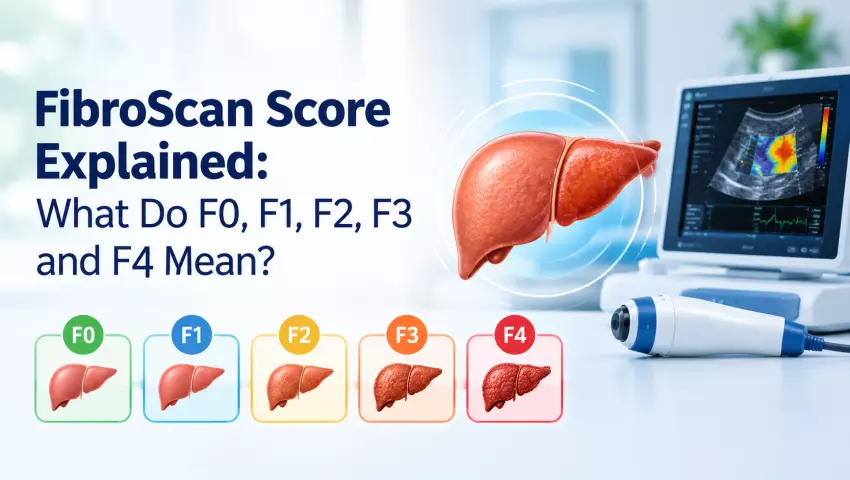
FibroScan Score Explained: What Do F0, F1, F2, F3 and F4 Mean?
You got your FibroScan report. It has many numbers and strange words. You may feel scared.
Please relax. A FibroScan score only tells you how healthy your liver is. In this blog, we explain your FibroScan score in very simple words.
This guide is by Dr. Vikrant Kale. He is a gastroenterologist, hepatologist and interventional endoscopist with 18+ years of experience.
What Is a FibroScan Test and Why Is It Done?
FibroScan is a quick and painless test. It checks the health of your liver without any needle or cut. It takes about 10 to 15 minutes.
A small probe is placed on the skin over your liver. It sends gentle vibrations into the liver. The machine measures how fast these vibrations travel. This gives your liver stiffness measurement.
Doctors advise this test for people with:
- Fatty liver
- Hepatitis B or C
- Type 2 diabetes
- Regular alcohol use
- Abnormal liver function tests
A FibroScan test is available at many liver clinics and hospitals. Always choose a centre with a trained operator.
What Does a FibroScan Score Tell You About Your Liver?
The report gives you two main numbers:
- Liver stiffness (kPa): shows scarring in the liver. This is called fibrosis.
- CAP score: shows how much fat is in the liver.
A healthy liver is soft. A scarred liver is hard. So, a higher number usually means more scarring.
Understanding Liver Fibrosis: What Do F0 to F4 Stages Mean?
Fibrosis means scar tissue in the liver. It forms when the liver is injured again and again. The injury may come from fat, alcohol, a virus or a medicine. Each time, the liver tries to heal itself. But healing leaves behind small scars.
Think of it like this. If you keep hurting the same spot on your skin, a hard scar forms. In the same way, repeated injury makes the liver stiff.
Doctors divide this scarring into five liver fibrosis stages. Your FibroScan fibrosis score is written as F0, F1, F2, F3 or F4. The higher the number, the more the scarring. Let us understand each stage in detail.
F0 Fibrosis: What Does No Liver Scarring Mean?
F0 means there is no scarring. Your liver is soft and healthy. It is doing its work well, like cleaning the blood, making bile and storing energy.
What should you do?
- Eat a balanced diet with less sugar and fried food
- Exercise for at least 30 minutes daily
- Limit or avoid alcohol
- Get your liver tests done once a year if you have risk factors like diabetes or obesity
F1 Fibrosis: What Does Mild Liver Scarring Mean?
F1 is mild liver fibrosis. There is a very small amount of scar tissue around the liver’s blood vessels. It is common in people with fatty liver. Most people feel completely fine at this stage and have no symptoms.
The good news is that F1 is easy to treat. The liver can heal well at this stage.
What should you do?
- Lose extra weight slowly
- Cut down on sugar, sweets and cold drinks
- Stop alcohol
- Repeat the FibroScan after 1 to 2 years, or as your doctor advises
F2 Fibrosis: What Does Moderate Liver Fibrosis Mean?
F2 is moderate liver fibrosis. The scarring has spread beyond the blood vessels into more areas of the liver. Your liver still works well. Most people still have no symptoms.
This is a very important stage. Many doctors treat F2 as the point where action must begin. If the cause is found and treated now, further damage can be stopped. Many patients also improve to a lower stage.
What should you do?
- Meet a doctor to find the exact cause
- Get blood tests and an ultrasound done
- Control diabetes, cholesterol and weight
- Take medicines only as prescribed
F3 Fibrosis: What Does Advanced Liver Fibrosis Mean?
F3 means advanced scarring. Many bands of scar tissue are now present in the liver. The liver is stiffer, and blood flow through it starts to slow down. It is not cirrhosis yet. But it is just one step away.
At this stage, the risk of future liver problems goes up. The good news is that F3 can still improve if the cause is treated on time.
What should you do?
- See a liver specialist soon
- Follow the treatment plan strictly
- Avoid alcohol completely
- Go for regular follow-up tests every 6 to 12 months
F4 Fibrosis: Does It Mean Liver Cirrhosis?
Yes, F4 usually means cirrhosis. Scar tissue has spread all over the liver. The liver becomes hard and small, and it cannot work as well as before.
Cirrhosis cannot always be fully reversed. But please do not lose hope. With proper treatment and regular check-ups, many people live well for many years. Treatment can stop the damage from growing. It also lowers the risk of problems like fluid in the stomach, internal bleeding and liver cancer.
What should you do?
- Consult a hepatologist without delay
- Take all medicines on time
- Eat less salt and avoid alcohol completely
- Go for regular scans and tests to check for complications
- Get vaccinated for hepatitis A and B, if your doctor advises
FibroScan F0 vs F1 vs F2 vs F3 vs F4: What Is the Difference?
The table below compares FibroScan F0 F1 F2 F3 F4 at a glance. The kPa ranges are approximate. They can change with the cause of liver disease, such as fatty liver, hepatitis B or hepatitis C.
What Is a Normal FibroScan Score?
A normal FibroScan score is usually between 2 and 6 kPa. Most healthy adults fall in this range. The lower the number, the softer and healthier your liver is.
Your score can differ a little from person to person. Age, body weight and the way the test is done can all play a small role. So a reading of 6.5 or 7 kPa does not always mean there is a problem. Your doctor will look at it along with your blood tests and health history.
What FibroScan Liver Stiffness (kPa) Means?
kPa stands for kilopascal. It is the unit used to measure pressure. In FibroScan, it shows how stiff your liver is. This is why it is called the liver stiffness measurement.
Think of it like pressing a sponge. A fresh sponge is soft and bounces back easily. An old, dried sponge is hard. Your liver works in a similar way. A healthy liver is soft. A scarred liver is stiff.
Here is how to read your FibroScan kPa value in a simple way:
- Up to 6 kPa: Your liver is soft and healthy.
- 6 to 7.5 kPa: Slightly raised. This may point to mild scarring.
- 5 to 10 kPa: Moderate stiffness. A doctor’s check-up is advised.
- 10 to 14 kPa: High liver stiffness. This needs a proper medical review.
- Above 14 kPa: Very high. It often points to cirrhosis.
These ranges are only a guide. The exact cut-off can change with the cause of liver disease, such as fatty liver, hepatitis B or hepatitis C.
Doctors also repeat the test after some months or years. This shows whether your liver is improving or getting worse. So, one reading is useful. But a trend over time is even more useful.
What Is a Good FibroScan Score for a Healthy Liver?
A good FibroScan score is below 6 kPa. At this level, your liver has very little or no scarring.
But the stiffness number is only half of the story. Your CAP score should also be in the normal range. CAP measures fat in the liver. A normal CAP score is below 238 dB/m. So, a truly healthy liver has both a low kPa value and a low CAP score.
Many people have a normal kPa but a high CAP score. This means the liver has fat but no scarring yet. It is a good time to make lifestyle changes. Eat healthy, walk daily and reduce sugar and fried food. This can stop the fat from turning into scars later.
If both numbers are normal, that is great news. Just keep up your good habits and get your liver checked once in a while, especially if you have diabetes, obesity or a family history of liver disease.
Can Fibrosis Improve From F3 or F4 to a Lower Stage?
In many cases, yes. Your liver can heal itself if the cause is treated.
These steps help:
- Lose extra weight
- Eat healthy food
- Stop alcohol
- Treat hepatitis B or C on time
Many patients with F2 and F3 get better with timely care. F4 is harder to reverse. But treatment can stop it from getting worse. It also lowers the risk of problems.
What Causes Liver Fibrosis to Progress From F0 to F4?
Common causes are:
- Fatty liver and obesity
- Type 2 diabetes
- Too much alcohol
- Hepatitis B and C
- Some medicines and autoimmune liver diseases
Fibrosis grows slowly. It can take many years. So, early action can stop it.
Can Fatty Liver Cause a High FibroScan Score?
Yes. If fatty liver stays for a long time, it can cause scarring. This is very common in India today.
The FibroScan CAP score shows how much fat your liver has. Doctors use the CAP score for fatty liver to find its grade. The same test gives you this liver fat measurement FibroScan result.
Here is the CAP score meaning in simple words:
- Below 238 dB/m: normal
- 238 to 260 dB/m: mild fat
- 260 to 290 dB/m: moderate fat
- Above 290 dB/m: severe fat
How Accurate Is FibroScan for Detecting Liver Fibrosis?
FibroScan is very good at ruling out serious scarring. It is also good at finding cirrhosis. But no test is 100% perfect.
That is why doctors read your FibroScan test results along with blood tests and your health history. Sometimes an ultrasound is also needed.
What Factors Can Affect Your FibroScan Results?
Some things can change your reading:
- Eating just before the test
- Obesity or thick chest wall
- Inflammation in the liver or high liver enzymes
- Heart failure
- An inexperienced operator
Please do not eat for 3 hours before the test. Also, get it done by a trained expert.
What Should You Do If Your FibroScan Score Is High?
First, do not panic. A high score is a warning. It is not the final answer.
Follow these steps:
- Show your report to a liver specialist
- Get blood tests done
- Stop alcohol completely
- Eat healthy and exercise daily
- Keep sugar and cholesterol in control
- Do not take painkillers or herbal medicines without asking your doctor
FibroScan report interpretation is best done by a doctor. Numbers alone can confuse you.
FibroScan Score and Liver Disease: When Should You See a Liver Specialist?
A high FibroScan score does not always mean serious liver disease. But it shows that your liver needs a closer look. Liver disease often stays silent for years. So, it is wise not to wait for symptoms.
A doctor who treats liver diseases is called a hepatologist. He can find the cause of your high score and guide you on the right treatment.
When should you consult a doctor?
Please see a specialist if:
- Your score is above 7.5 kPa
- Your CAP score is above 260 dB/m
- Your score has gone up since the last test
- You have fatty liver with diabetes, or hepatitis B or C
- You feel tired, have a bloated stomach, yellow eyes or swollen feet
If you vomit blood or pass black stools, go to a hospital at once.
What does a hepatologist do?
The doctor does not look at your FibroScan score alone. Your medical history, blood tests and ultrasound are also checked. This helps find the exact cause of liver damage and plan the right treatment.
Early action protects your liver. Seeing a specialist at the right time can prevent serious problems later.
Frequently Asked Questions About FibroScan Scores:
A normal FibroScan score is about 2 to 6 kPa. Most healthy adults fall in this range. A reading slightly above 6 kPa does not always mean a problem, so your doctor will look at it along with your other tests.
These are the stages of liver scarring, also called fibrosis. F0 means no scarring and F1 means mild scarring. F2 is moderate, F3 is advanced and F4 means cirrhosis. The higher the number, the more the scarring.
A score above 12.5 to 14 kPa usually points to cirrhosis. The exact cut-off can change with the cause of liver disease, such as fatty liver or hepatitis. Your doctor will confirm it with blood tests and an ultrasound.
F2 is moderate scarring, so it needs attention. But it is not an emergency, and most people have no symptoms at this stage. If the cause is found and treated on time, the liver can often improve.
In many cases, yes. The liver can heal itself if the cause is treated early. Weight loss, a healthy diet, no alcohol and proper treatment of hepatitis can help a lot. Regular follow-up is important.
Mostly yes. F4 usually means the liver has heavy scarring, which is called cirrhosis. But the final diagnosis needs other tests too. With proper treatment and regular check-ups, many people with cirrhosis live well for years.
A high score means your liver is stiffer than normal, which usually points to more scarring. It is a warning sign, not a final diagnosis. Please consult a liver specialist to find the cause and plan the right treatment.
Yes. If fatty liver stays for many years, it can cause inflammation and then scarring. This raises your liver stiffness score. The good news is that weight loss and a healthy lifestyle can reduce both fat and scarring.
Conclusion: Understanding Your FibroScan Score and Liver Health
Your FibroScan score can give useful information about liver stiffness, fibrosis and liver fat.
F0 to F4 shows the different stages of liver fibrosis, from no significant scarring to cirrhosis. But your result should not be understood from the number alone.
If you have a high FibroScan fibrosis score, abnormal liver tests or concerns about fatty liver, it is important to consult Dr. Vikrant Kale, Consultant Gastroenterologist, Hepatologist and Interventional Endoscopist, provides evaluation and treatment for liver-related conditions.
Early evaluation can help identify the cause of liver damage and guide the right treatment and follow-up for better long-term liver health.